
[Όποιος/α μεταπτυχιακός/ή φοιτητής/τήτρια ενδιαφέρεται να επικοινωνήσει πρώτα με την κ. Γαλανίδου (galanidou[at]uoc.gr) στέλνοντάς της το βιογραφικό του/της στα αγγλικά.]
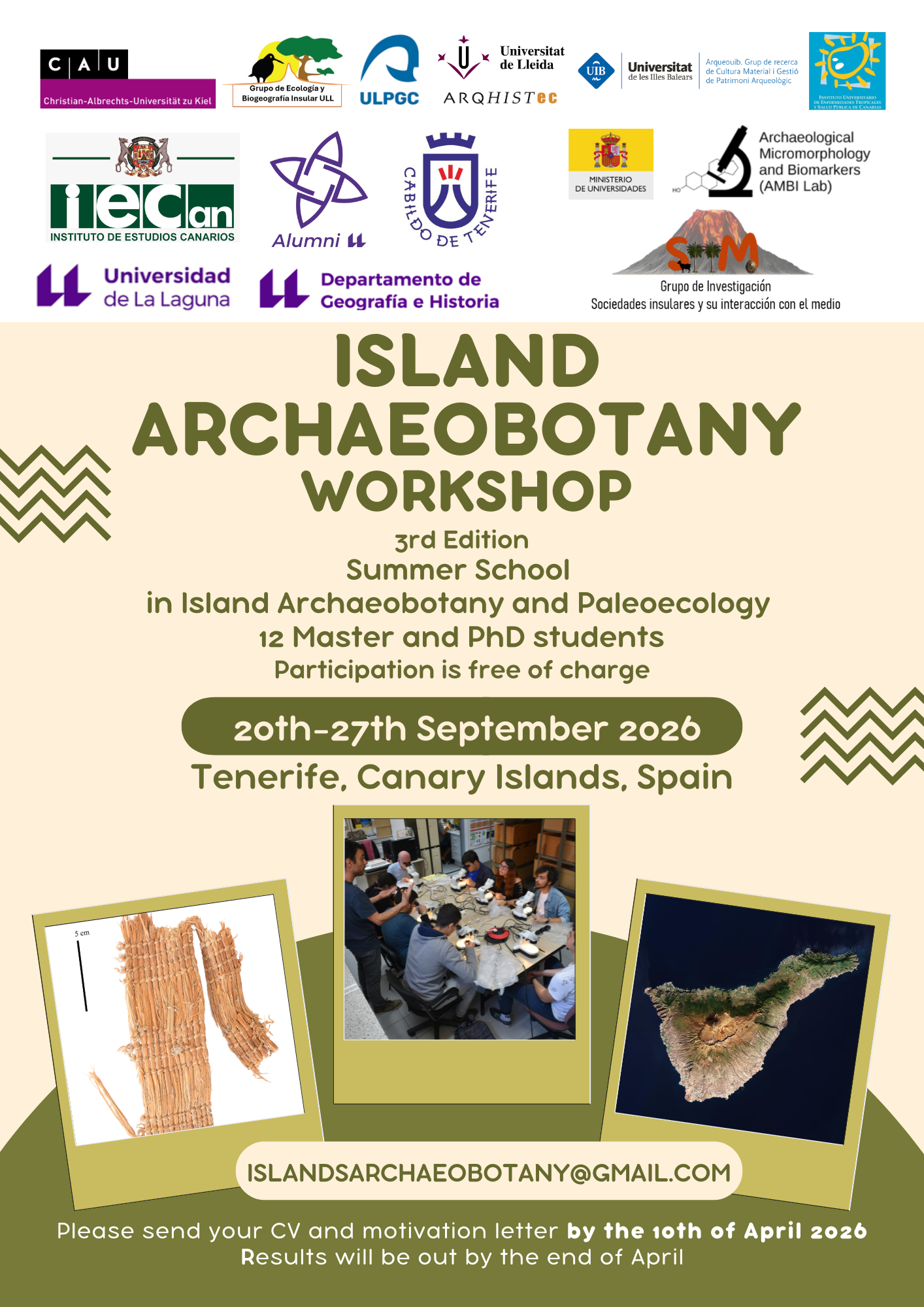
We are delighted to announce the third edition of the Summer School in Island Archaeobotany for Master and PhD students in Archaeobotany and Paleoecology.
After the success in Pantelleria (Sicily, Italy) in 2024 and in Mallorca (Balearic Islands, Spain) in 2025, the host of 2026 edition will be the island of Tenerife, University of La Laguna (Canary Islands, Spain).
The Summer School aims at expanding the knowledge on human-plant interactions on small islands since the first human colonisation. Islands are geographically isolated environments with specific features in biodiversity and available resources. Humans learned how to adapt and how to exploit the local resources, but also introduced new species and developed local strategies to manage the woodland and to grow the crops.
Tenerife will serve as the framework for the workshop. The island, the largest of the Canary archipelago, is the product of complex volcanic processes associated with the Canary hotspot. From a historical perspective, prior to the Castilian conquest in the 15th century, Tenerife was inhabited by the “Guanche” people, who developed pastoral and agricultural practices adapted to the island’s steep topography and limited water resources. Ecologically, Tenerife hosts an exceptional gradient of environments generated by altitude, trade winds, and volcanic soils. Within a relatively small territory, ecosystems range from coastal xerophytic vegetation to humid laurel forests and high-altitude volcanic shrublands, supporting a high concentration of endemic species and making the island a key site for the study of island biogeography and ecological adaptation.
We believe that the island is the perfect place to host such an event!
The Summer School may host up to 12 Master students/PhD students in archaeology, bioarchaeology, ecology, biology, agroforestry, cultural anthropology. They will be involved in theoretical and practical sessions, including fieldwork, laboratory work and trips to the most significant places of the island and will culminate in the writing of a small group project. The teaching team will be composed by local and international researchers and professors working on the Canary Islands and other insular contexts.
The event is free of charge for participants and the accommodation and local transport is provided by the organisation.
If you need more information or you wish to send your application, please do so before the 10th of April via: islandsarchaeobotany@gmail.com, including a CV and a motivation letter.
Όποιος/α μεταπτυχιακός/ή φοιτητής/τήτρια ενδιαφέρεται να επικοινωνήσει πρώτα με την κ. Γαλανίδου (galanidou[at]uoc.gr) στέλνοντάς της το βιογραφικό του/της στα αγγλικά.